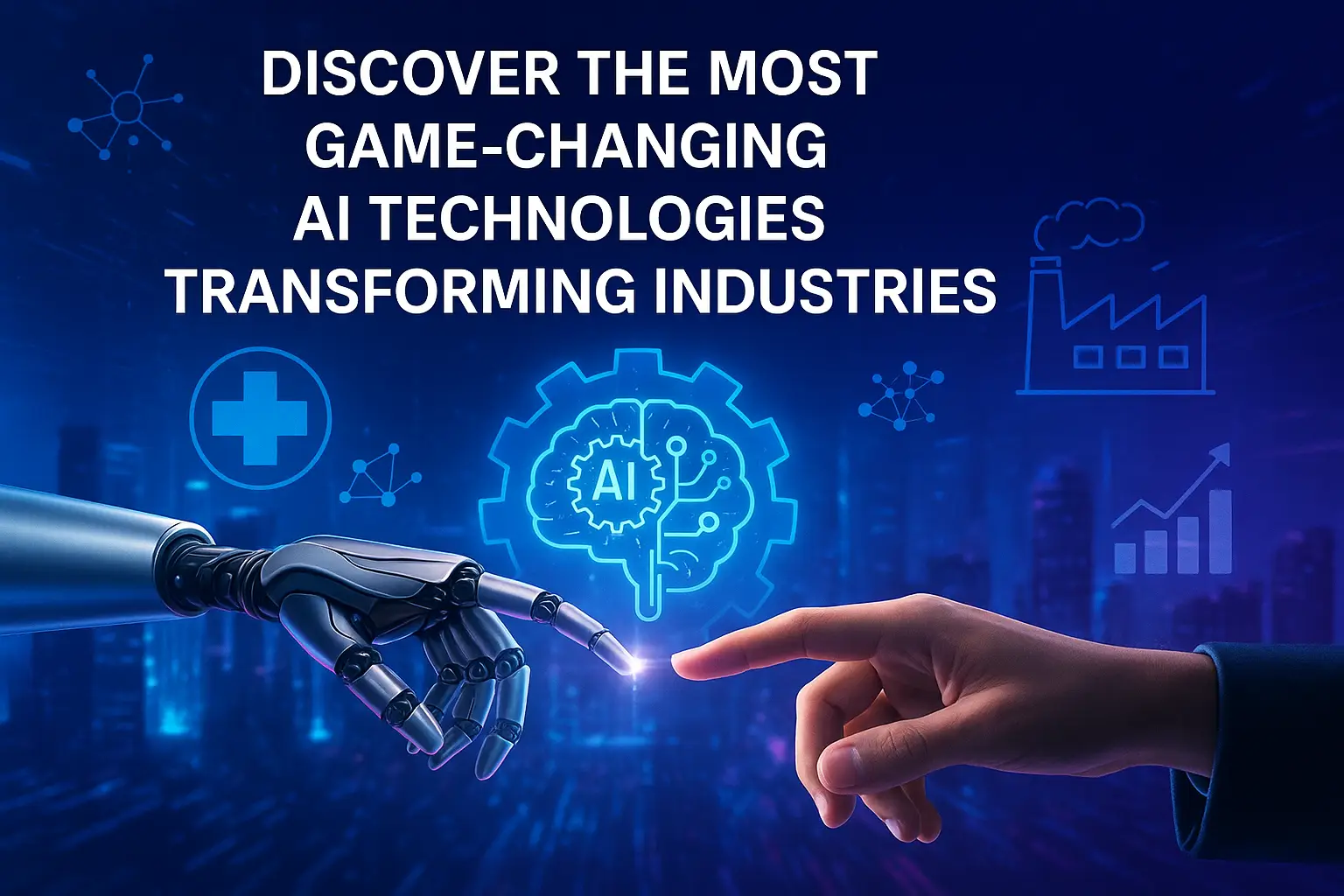
Discover the most game-changing AI technologies that are transforming industries and solving real-world problems with innovative solutions and formulas.
Introduction
Artificial Intelligence (AI) is no longer just a futuristic concept; it is a powerful force revolutionizing industries today. Game-changing AI technologies are at the heart of this transformation, reshaping healthcare, finance, education, and even entertainment. In this article, we will explore how these technologies work, provide real-world examples, and even use mathematical formulas to show how AI solves complex problems effectively.
Want to dive deeper? Learn how to get started with AI here.
What Are Game-Changing AI Technologies?
Game-changing AI technologies refer to innovations that dramatically enhance how we solve problems, make decisions, and automate tasks. These technologies improve efficiency, accuracy, and scalability across multiple sectors.
- Machine Learning (ML)
- Natural Language Processing (NLP)
- Computer Vision
- Reinforcement Learning
- Generative AI (e.g., ChatGPT, DALL·E)
Additionally, AI tools for productivity are helping businesses scale faster than ever.
Key Game-Changing AI Technologies and Their Real-World Applications
1. Machine Learning (ML) in Predictive Analytics
Machine Learning enables computers to learn from data and make predictions. A classic formula used in ML is the Linear Regression model:
y = β₀ + β₁x₁ + β₂x₂ + ... + βₙxₙ + ε
Explanation: In simple terms, Linear Regression tries to find a straight line that best fits the data points. It helps predict a future value (y) based on past known values (x₁, x₂, etc.). The coefficients (β) adjust how much weight each input feature has.
Real-world example: Banks use ML to predict customer creditworthiness, improving loan approval processes and minimizing risks. Learn more about how AI is helping small business owners.
2. Natural Language Processing (NLP) in Customer Service
NLP helps machines understand and respond to human language. One common technique is TF-IDF (Term Frequency–Inverse Document Frequency):
TF-IDF(t,d) = TF(t,d) × IDF(t)
Explanation: TF-IDF measures how important a word is in a document compared to a collection of documents. It boosts important words and downplays common ones like "the" or "is," helping AI better understand text context.
Real-world example: Chatbots use NLP to automatically handle customer inquiries, saving businesses millions annually. Explore more in how AI is revolutionizing customer support.
3. Computer Vision in Healthcare Diagnostics
Computer Vision allows AI to "see" and interpret images. A key metric used is Accuracy:
Accuracy = (TP + TN) / (TP + TN + FP + FN)
Explanation: Accuracy measures how often the AI model is correct. TP = correctly predicted positives (e.g., diseased patients), TN = correctly predicted negatives (healthy patients), FP and FN are errors. High accuracy is vital for trust in medical diagnoses.
Real-world example: AI can detect diseases like cancer from medical imaging with over 90% accuracy. Discover how AI is shaping the future of healthcare.
4. Reinforcement Learning for Autonomous Vehicles
In reinforcement learning, agents learn by receiving rewards for actions:
Q(s,a) = r(s,a) + γ max Q(s',a')
Explanation: This formula teaches the AI which actions (a) to take in a situation (s) by maximizing rewards. It’s like teaching a dog tricks using treats. Over time, the AI becomes better at making decisions.
Real-world example: Self-driving cars, like those from Tesla, use reinforcement learning to optimize driving strategies. Learn more about the future of remote work and AI's role.
5. Generative AI in Creative Industries
Generative AI models like GANs (Generative Adversarial Networks) create new content by learning data patterns:
minG maxD V(D,G) = Ex ~ pdata(x) [log D(x)] + Ez ~ pz(z) [log(1 - D(G(z)))];
Explanation: Generative AI pits two neural networks against each other — the Generator tries to create realistic outputs while the Discriminator tries to catch fakes. This battle makes the generator better and better over time at producing "real" looking content.
Real-world example: Artists and designers are now using AI tools to generate original artwork, music, and even marketing content. Check out how AI is creating art.
Related Articles You May Enjoy
- AI is Revolutionizing Customer Support
- Best AI Software for Marketing Automation
- AI Create Art: The New Era of Creativity
- Get Started with Artificial Intelligence
- AI for Small Business Owners
- AI is Shaping the Future of Healthcare
- AI is Changing Education
- The Future of Remote Work: Trends and Technologies
- Top AI Tools for Productivity
Why Are Game-Changing AI Technologies Important?
These technologies offer transformative benefits:
- Scalability: AI can handle massive datasets effortlessly.
- Efficiency: Processes are automated, saving time and money.
- Innovation: AI opens the door to new creative and business opportunities.
- Problem-Solving: AI can solve problems that were once deemed too complex for human intelligence.
Conclusion
AI is revolutionizing our world in ways we could not have imagined just a decade ago. From healthcare diagnostics to self-driving cars, AI technologies are making industries smarter, more efficient, and more capable than ever before. As we continue to innovate, we can only expect AI to play an even bigger role in shaping the future of business, education, and beyond.
Stay tuned to our website for more in-depth analysis and updates on the latest in AI technologies!